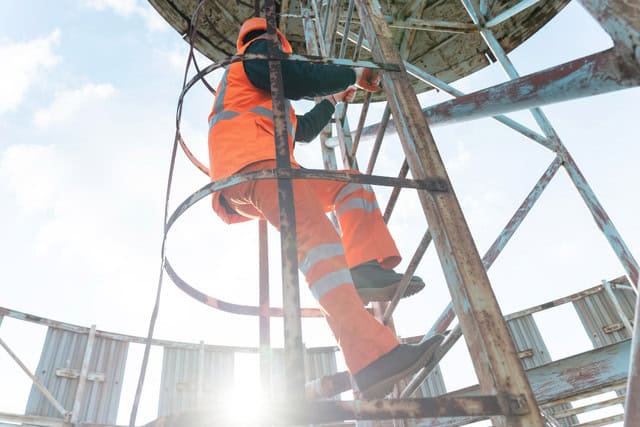
Too many companies are ticking a compliance box with generic lone worker policies that were clearly written with an office environment in mind, not the people actually working alone in genuinely hazardous conditions. The protocols look fine on paper, and they hold up well enough in a board presentation, but they were never really built for the field.
Most lone worker protection measures assume a fairly comfortable set of circumstances, indoors, flat surfaces, and a moderate temperature. That’s a reasonable picture of someone working from home on a Tuesday afternoon. It has almost nothing to do with someone who is truly isolated, exposed to the elements, and a long way from help if something goes wrong.
There’s a world of difference between feeling a little lonely on a remote workday and being completely on your own in a physically dangerous environment with no one around to notice if you don’t check in.
Static Risk Assessments Don’t Survive Contact With the Real World
While annual assessments have their place, they’re also not fit for purpose, they describe the world in the state it was when someone sat down and filled out a form. The only way to make a risk assessment truly dynamic is to treat each new site arrival as its own risk event.
This matters most for community-facing roles. Social engineering is a genuine threat for workers doing home visits or community outreach. An aggressive individual doesn’t announce their intentions, and a worker who’s been trained only to press a panic button after a situation escalates is already behind. Discreet invocation, the ability to trigger an alarm silently, without raising a phone or pressing an obvious button, is one of the most undervalued features in the entire device market. If activating help visibly might make a volatile situation worse, the technology has to allow for invisible activation.
The Silent Risks That a Panic Button Can’t Catch
For solitary workers in industrial settings, the potential risks are not related to other humans. For instance, a worker in a confined space is not fearing a human adversary. Instead, they might be worrying about the accumulation of gas, depleting levels of oxygen, or a fall that might render them immobile and unable to raise an alarm.
A man-down detection feature can help with this immobilization issue. If a worker collapses or stops moving for a long enough period, the device will automatically send an alert. Paired with environmental detectors like gas sensors or thermal monitors, the system will be able to respond to the very real dangers that the worker might not even be aware of.
Mapping the Communication Gap
It doesn’t matter how good your hardware is if you have no signal. An inadequate but overlooked phase of program design is to perform an exhaustive coverage audit. This is where you determine exactly where your GSM signals drop out, where Wi-Fi has a blind spot, and what part of the world you are relying on infrastructure that fails under stress.
High-risk remote roles may need satellite messaging capability straight up. A device that works in 95% of locations and fails in the 5% that are the most isolated is precisely backwards from a safety point of view. The audit process should map worker routes and fixed locations against coverage data, and any identified gap should drive a hardware or network decision, not a “we’ll note it for next review.”
Devices that can toggle automatically between Wi-Fi, GSM, and satellite without worker intervention are worth serious consideration for field-heavy operations. The worker shouldn’t need to manage their connectivity under pressure.
The Financial Case for Getting This Right
Over half of all companies do not track the cost to their business of grievances and litigations from emergency events (such as a lone worker incident). The real costs of an under-bid to win a contract, fewer resources on-site, cutting corners with training, upkeep, and monitoring costs, often only become apparent after it is too late.
Total Cost of Ownership estimates of a solution that includes serious incidents and major breaches tend to yield surprisingly larger numbers than the sums involved in putting in place the right protection and monitoring resources in the first instance. The Lone Worker Call Cost Calculator is a practical tool for organisations working through this, helping translate current call and check-in volumes into actual cost exposure.
Total Cost of Ownership thinking asks leaders to ask tougher questions about avoiding events, eliminating business risk, covering all employees who could be exposed, and occupying the full duty of care version.
Making the Technology Match the Threat
Adhering to compliance standards such as BS 8484 sets the minimum level for delivering lone worker protection services and it is imperative to implement them. However, for roles that are genuinely high-risk, this minimum level is not enough. The challenge lies in identifying the most suitable devices and monitoring solutions based on the realistic level of threat associated with each type of role, instead of deploying a homogeneous solution for all scenarios and expecting it to be effective.
Knowing that the alarm will be properly handled by a Professional Alarm Receiving Centre according to SLAs, and that the emergency services will be dispatched if they are required, is the “building” around the device that really brings out the device’s potential.
Good lone worker protection is not rocket science, but it is serious stuff. It requires the same care and attention as you would pay to all your other critical systems: regular reviews, clear ownership, and a preparedness to invest in the areas where the risk lies.